


Friends,
Welcome to Part 4, and thank you for your patience. No need to have read the previous essays to enjoy this one, but I’ve left the links below. This final installment makes three key claims: (1) that Jesus’s promise about moving mountains is more central to the Christian faith than we have supposed, (2) that mountain-moving faith is more like a language than a belief, and (3) that Jesus came to make us native speakers. Sounds simple enough. But the road from Babel to Pentecost is often a long and winding one, and this essay is one such road. At least now you know where it leads.
– Ross


Now out of the ground the Lord God had formed every beast of the field and every bird of the heavens and brought them to the man to see what he would call them. And whatever the man called every living creature, that was its name. (Genesis 2:19)
But others mocking said, “They are filled with new wine.” (Acts 2:13)
The Saint That Moved A Mountain
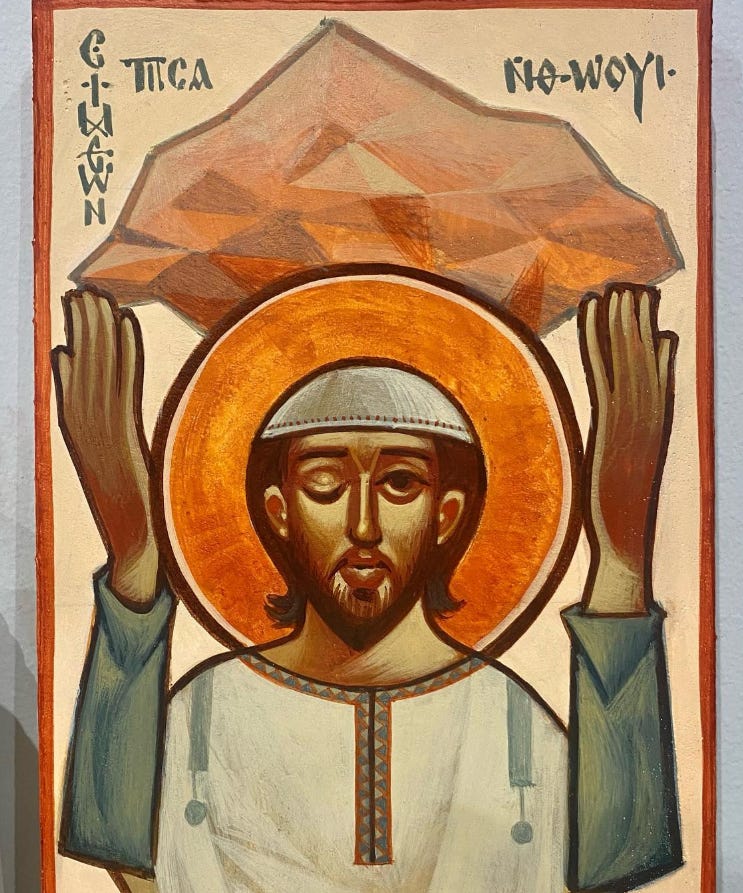
Somewhere, in the back alleys of the newly built city of Cairo, there lived a humble shoemaker named Simon, who would one day move a mountain with a word. It was the late tenth century, and Cairo had become the capital of the Fatimid Caliphate. The people of Egypt were still haunted by the recent memory of a terrible famine, which claimed the lives of over a half million men, women, and children. Needless to say, these were not easy times, even for the rich and powerful. But our Simon was no one of note. A poor man and a Christian, Simon had made it his habit to carry water each morning to the sick and elderly in his neighborhood before beginning his daily leather work.
We know nothing of his upbringing and nothing of his death. The bones of “Saint Simon the Tanner” were said to have been discovered in 1991 during the restoration of St. Mary’s Orthodox Church (the name of which will find greater significance later in this tale). To this day, if you go to Cairo, you can visit and venerate his remains there.
Of the actual life of Saint Simon, church tradition recounts only two main events. The first is this: One day, while practicing his profession, a beautiful woman came to him requesting that he repair her shoe. As she proceeded to remove the shoe, her leg showed and he caught himself looking at her lustfully. Now, I must remind you once again that Simon was a Christian, a disciple of the man who, at least as he understood it, had given quite clear instructions about what to do in such a circumstance. “If your right eye causes you to sin,” the teaching went. Thus, Simon knew what he must do. After the woman left, when he was all alone, he picked up the awl he used each day in his leather work and plucked out his right eye.
This act alone did not make Simon famous, nor did it make him any great saint. As far as Simon himself was concerned, it simply made him a Christian. And so he went on living his simple life—with one less eye—still relatively unknown and unnoticed, except by those who were daily blessed by the water he delivered and the shoes he repaired. This, however, was about to change.
Let the camera lens drift upward, away from the noisy, haggard streets of medieval Cairo, up, up, up to the pristine walls and the even more pristine inner courts of the grand palace in the middle of the city, where, seated on the throne we find the most powerful man in all of North Africa, the caliph of the Fatimid Empire.
Caliph Al Muizz prided himself in being something of a philosopher and a poet. Though a devout Muslim himself, he was fond of hosting debates especially with Jewish and Christian thinkers, where he allowed them to speak freely, seemingly without the threat of punishment. In one such gathering, the Coptic Pope Abraham was getting the better of a well-known Jewish scholar in a debate about which religion was the true. In a kind of last ditch effort, the Jewish scholar unsheathed his secret weapon. He quoted Jesus in the Gospel of Matthew:
For truly, I say to you, if you have faith like a grain of mustard seed, you will say to this mountain, ‘Move from here to there,’ and it will move, and nothing will be impossible for you.
“Are these the words of your Christ?” the rabbi declared with no small amount of dramatic flourish.
“They are,” Abraham replied.
“And you believe them?”
“I do.”
“Then prove it.”
As the rabbi spoke, he called the attention of everyone in the room to the palace window, where there, perfectly framed, stood Cairo’s Mokattam Mountain.
The rabbi’s words had hit their mark. Even the caliph was on his side now.
“The rabbi has a point,” the caliph’s voice echoed from the throne. “If the words of your Christ are true, you will perform this miracle. If you cannot, you will have proved yourself a liar in my court, the penalty of which is death, not only for you but for every adherent of your lying faith in my kingdom.”
Abraham knew the caliph was not one to bluff. And though he had no idea how to move a mountain, he did not despair. Instead, he requested three days to carry out the miracle. The caliph agreed.
When Pope Abraham left the palace, he called upon every bishop and priest in Cairo and told them to fast and pray for the next three days. This was not your typical miracle, after all. As far as they knew, no one had ever moved a mountain. Not even Christ himself had moved a mountain. But he had promised that such a thing was possible for those with even a mustard seed of faith. And so, Abraham trusted, prayed, and waited.
On the third day, as he was praying in the church, Abraham had a vision. In the vision, Mary, the mother of Christ, came to him with a message. There was a man in the marketplace, she said, a man with only one eye, carrying a pot of water. Go and find him. He will know what to do.
Abraham went, and soon enough, he found our Simon. He brought him to the foot of the mountain at the appointed time. There stood the caliph with his royal guards. There, too, stood the bishops and the priests and many others besides, waiting to see what God would do through Abraham and this one-eyed shoemaker from nobody-knows-where. Not even Pope Abraham knew.
But when the time was right, he looked to Simon, and Simon said simply, “Kyrie Eleison” (“Lord have mercy”). Abraham repeated the prayer. “Kyrie Eleison,” he said, performing the sign of the cross over the mountain.
For a moment, nothing happened. All was silent. And then the mountain…moved. Mokattam Mountain uprooted itself and lifted completely off the ground so that sunlight shone underneath for everyone to see.
“Again,” said Simon. And Pope Abraham and the bishops and priests said the prayer a second time. And the mountain was again lifted up, the light shining underneath even brighter than before.
“And again,” said Simon. “Lord have mercy.” The mountain was lifted a third time.
Of course, all were amazed. The caliph was struck speechless with fear. Abraham turned to look for Simon, but he had already disappeared back into the crowd, his role accomplished.
In the weeks that followed, Caliph Al Muizz gave up his throne and, if you can believe it, was baptized as a Christian. In commemoration of the miracle of Mokattam Mountain, Coptic Christians from that day to this have added three extra days to their Advent fast (43 days instead of the normal 40), and a church now exists in the hollowed out part of the mountain which was thought to have fallen away on the day when that mountain was moved with a word.
That is the story of Saint Simon the Tanner.
The Language of Eden

About a year ago, I released the first installment of this essay series exploring the meaning of Jesus’s enigmatic statement about moving mountains. I admitted then that I struggled to believe it myself. I had a microbe of faith, which I prayed would become a mustard seed over time. That is still my prayer, and I believe God is answering it, though I confess I have not reached Simon the Tanner status yet. But when I came across this story, I felt certain it was true, not merely true in the sense that it happened (though I believe it did), but true in the sense that it revealed the pattern of all such happenings. I felt that I finally understood why I couldn’t move a mountain and why Simon could. It was as though a missing puzzle piece had dropped into place, and the whole picture seemed to take on a new depth and color. “Of course,” I thought, “that is how mountains are moved.” In this final essay, I’m going to try to paint that picture for you, as I now see it.
In short, I believe Simon the Tanner moved Mokattam Mountain, because he spoke a language the mountain could hear and obey. Specifically, I believe he spoke the language of Eden, the forgotten language with which Adam first named the animals. “And whatever the man called them,” the Book of Genesis says, “that is what they were.” Word and reality completely aligned.1 Of course, to us Simon’s story reveals no such majestic dialect. Simon only says, “Lord have mercy,” and the pope repeats the same. Then again, it is difficult to recognize a language we do not speak.
I tell you the truth, the kingdom of God is like a foreign tongue, which a man hears but does not comprehend. The words ring in his ears, but to him, they are nothing but sounds; and the secret remains hidden in plain sight.
The secret of Simon’s remarkable faith is hidden in the most unremarkable of places: his ordinary life. Before Simon ever spoke to the mountain with the voice of his Lord, he had already quietly integrated the words of his Lord into himself. Simon had learned to speak the language of dominion, passed down from the Father to the Son to the disciples to the world. Faith, as it turns out, is a language, and Jesus came to make us into native speakers. You might say, in a manner of speaking, he came to give us the gift of tongues. This essay is about how we can receive it as Simon did. But first, a word about sainthood itself…
Priests and Saints
A friend asked me the other day if I believed that all Christians should be called “saints.” He’d been reading a book by a well-known evangelical author who rejected the Catholic notion of canonized sainthood in favor of a more universal understanding of the term. “Every true believer,” the author said, “has been set apart by God for God…[A saint] is someone whom Christ bought with His own blood on the cross and has separated unto Himself to be His own possession.”2 I understand his main point, and I especially like the language of “set apart.” And yet, something still feels off about it.
For me, the sainthood of all believers is akin to the priesthood of all believers. Both are powerful notions, but both can become less-than-helpful if not treated with the utmost care. Yes, all believers are declared—and must necessarily become—priests (and saints) in Christ. But the casual conflation of being and becoming is taking its toll. We are losing sight of the call-and-response economy of God and replacing it with a presumption of cause-and-effect. We see power where we should see authority, a God who zaps rather than a God who woos. I agree that Christ has set apart every Christian unto himself by his blood, but set apartness is not something God simply does to us wholesale; it is something he slowly accomplishes in us. Which is to say, set apartness is also something we do in response to him.3 Holiness is the fruit of relationship. Thus, some Christians really are holier than others, but they are holier for our sake.
Many in the church today have forgotten that we need some to be priests over us, so that all of us can become priests, just as we need some to be our fathers and mothers before we can become fathers and mothers ourselves. If all are priests in the exactly same way, then none are priests at all. If all in the church are “born again,” but none have grown in maturity toward the measure of the stature of the fullness of Christ (Eph. 4:13), then we risk becoming a church full of babies. And that is exactly what some of our churches appear to be.
Likewise with saints. The church needs saints, not just the historical, canonized kind, but the ordinary, living-and-breathing kind. We need some men and women to be truly set apart—or at least aiming to be so—so that all might become like them by following in their footsteps. “Imitate me,” said Saint Paul, “as I also imitate Christ.” If even one holy person in the church has moved a mountain, then perhaps all of us can one day do the same. But if we pretend that all can move mountains, we can be certain no one ever will.
Now, one thing that used to confuse me a little about the Catholic canonization of saints is the requirement of documented miracles. One would think a manifestly holy life would be enough qualification. (And indeed, in certain cases, it has been.) Yet the requirement of miracles may not be as strange as it first appears. Consider, for instance, the central role miracles play in the ministry of Jesus. What is the purpose of all these signs and wonders? Many of our contemporary formulations of “the gospel” can hardly find a logical place to fit them amidst all our talk of the cross. But before that climactic event, there is hardly a page of the Gospels in which Jesus is not healing the sick, raising the dead, making the blind see and the lame walk, casting out demons, calming storms, walking on water, feeding multitudes, turning water to wine, etc. Then, after the resurrection, turn to the Book of Acts, and what do you find? The same general pattern, but this time, his followers have picked up where he left off, possibly even doing “greater things” than he, as again he had promised they would, with the help of the Spirit (Jn. 14:12). Even Peter’s shadow seems somehow to have wonder-working power (Act. 5). Such miraculous signs, apparently, are what we should expect from those holy ones who walk in the footsteps of Christ. And, lest we be tempted to doubt, Christ himself makes this all the more clear in the central passage on which this essay series is based:
For truly I say to you, if you have faith like a grain of mustard seed, you will say to this mountain, ‘Move from here to there,’ and it will move, and nothing will be impossible for you. (Matthew 17:20)
Why is this so hard for us to believe? In part, I think it’s because many of us have grown up with what I call a gospel of contrast: Christ is; we are not. Christ did; we cannot. Christ laid down his life for us, so that we don’t have to. And it’s true, as far as it goes: While we were still sinners, Christ died for us. Such contrast between his wealth and our poverty is the necessary starting point of all true love for him, however, it is not the end. In the words of George Macdonald, “Love loves unto purity.” If the Father has sent out his Word, it will not return to him void. We cannot, in good conscience, say we believe the Son came and died to make us like him as we continue to despair of ever actually becoming like him. Either love is as strong as death, or it is not. Either Christ is a good high priest, or he is not. And if he is good, then he is fulfilling his office, not only retaining his own holiness, but making us holy like him. “For them I sanctify myself, that they too may be truly sanctified” (John 17:19).
Which leads one to ask: If the New Testament is the story of how Jesus Christ has saved and is saving the world through faith in him, and if saving us means making us holy as he is holy, and if such faith and holiness is constantly seen to be producing the fruit of miraculous signs and wonders in Scripture and throughout church history, and if Christ himself explicitly promised that this is exactly what would happen, then what are we missing? Why does the “faith” required for mountain-moving seem to us to be a completely different kind of faith than that required for salvation? If moving a mountain requires faith like a grain of mustard seed, how much faith is required to be saved? Is it more or less? Is it the same kind of faith or a different kind? What is the link between faith, miracles, and salvation? If we cannot command mountains—if we have not the authority to command even our own bodies and minds—should we wonder whether or not we have any part in Him?
I think…we should not wonder. But that is only because I believe in the necessity of saints and priests as I believe in the necessity of fathers and mothers: that some have gone before us, paving the way to a faith (and faithfulness) which all who are baptized into Christ must and shall possess, a faith that not only moves mountains, but heals the human heart. The latter is no less “impossible”—and therefore no less miraculous—than the former. Indeed, it is more. But as long as we continue to believe that the power of sin has more say over us than the authority of God, I fear we will continue to see very little of both kinds of miracles here and now.
What I am saying is that the primary message behind Christ’s miracles is not, as has often been supposed, a gospel of contrast, that God can do what we cannot, but rather a gospel of participation. Of course he can do what we cannot; he is God after all. But when Christ casts out a demon, calms a storm, or makes a blind man see, he has a much more specific communicative purpose in mind: to show his disciples what they must also do, and to invite them to start doing it. Jesus Christ is not so much our heavenly antithesis as our earthly plausibility structure. He is the second Adam, so that we might become the third. Why, again, did he walk on water, if not to call Peter to do the same? Of course, Peter couldn’t do it as Christ did. Not at first. But, like a child taking his first steps, he did do it. And in so doing, that act of “little faith” became a doorway to a new world of possibility. And that doorway, dear friends, is still open to us.
Of course, we cannot be fully blamed for doubting the “priests-and-saints” method of saving the world. The disciples doubted it too, especially given the obvious failures of the priestly class in their day. Why not just do the thing himself, all by himself? Wouldn’t that be a lot easier for everyone? Sure, but that isn’t the Father’s way.
As the previous essays in this series have shown, God prefers authority to power. He made the world by call-and-response, not cause-and-effect, and he plans to remake it in like fashion. “Things” can be fixed, but God did not make things. He made agents and choosers (even the sun and moon and the fish and birds are given roles and commands). He made lovers, who have come to love the wrong things. The question is: how can they be put right again? Power undermines the agency of the other, but proper authority restores and redeems agency by calling the other—be it a mountain, a storm, or a human being—to submit freely to that which is most worthy of obedience. In a sense, they’re almost opposites. From Genesis 1 to the present, the way of authority has been God’s way, despite the fact that we and Satan in the desert and Dostoevsky’s “Grand Inquisitor,” might all argue to the contrary: “Just turn these stones to bread already!” But Jesus will not strike the rock of our hearts when the Father has instructed him to speak to it. All of the prophecies about stone hearts turning to flesh will come to pass. He will give us new hearts. The miracle is at hand, but it isn’t necessarily the miracle we would have chosen.
We want miracles to be zaps. Zap the mountain; zap the heart. But hearts are not so easily changed. Even the mountain must be spoken to before it will move, because mountains were also designed for call and response. “You will say to this mountain, ‘Move from here to there, and it will move.’” The difference between us and the mountain is that we were not only made, like the mountain, to obey, but also, like our Maker, to rule. And this makes our redemption much more complex—and also much more beautiful—than that of the mountain. Our salvation requires participation. To be a Christian means to become a saint and a priest: not only a recipient of, but an instrument in, the redemption of the world. If we want to be forgiven, we must also learn to forgive. If we want to speak to the mountains, we must also learn to speak to our own hearts and to the hearts of our neighbors.
“Who then can be saved?!” With man this is impossible, but with God all things are possible. Of course, it’s a bit too easy to say that God ‘makes the impossible possible’, much harder to make the impossible plausible for those who want to believe. “We believe; help us in our unbelief!” Thankfully, this has been Jesus’s purpose all along, and it’s also the purpose of his saints. Which brings us back to Simon…
Holy Simplicity

In considering the story of Saint Simon the Tanner, I’m struck by two almost contradictory intuitions about faith, both of which seem to find deep roots in Simon’s own life. Let’s call them holy simplicity and holy complexity. For much of my life, I couldn’t help but treat these two intuitions—the “immediate yes” of the mystics, the Kierkegaardians, and the charismatics versus the “long obedience” of traditional religion—as almost opposing camps within Christianity. I now see them as something like different sexes of the same species, which appear as opposites, yet which are destined to meet, correct, and complete one another in the kingdom of God and in his saints. Simon the Tanner is certainly one of those saints.
It goes without saying that Simon’s story is a story of simple faith, in the best sense of the word. Just meditating on it seems to be correcting (and completing) something in me. By holy simplicity, I mean the notion that true faith has to do with something so stripped down as to be almost irreducible. Yet simplicity alone is no virtue. There is also such a thing as an unholy simplicity. There is something irreducible about narcissism, but that doesn’t make it good or fruitful. The mustard seed is the perfect picture of holy simplicity, because a mustard seed is not only small, but also a seed. A pebble or a speck wouldn’t hold the same significance. A seed is like a child, or more precisely, like a fetus: a thing as close to birth and as far from maturity as can be imagined. Yet the whole complex pattern is stored up inside, waiting—not rushing—to be actualized.
Now, just as a whole tree comes from a single seed, a whole mountain can be moved with a single seed of faith. All who have this seed of faith, our Lord says, can do such things. The ability, the authority, is shockingly closer than we think. If we seem to have faith, but cannot access this authority, it may be that our faith is not so much a true seed as a false tree—something already grown, but grown awry. It’s not that we have too little, but too much of the wrong thing. Like the rich young ruler, we’ve grown too wealthy to claim our true inheritance, too old of a dog for new tricks.
This holy simplicity is what makes Simon the Tanner so extraordinary. He isn’t the pope. He isn’t even a priest. He isn’t the one making complex arguments in the caliph’s court. He wouldn’t have ever been invited, since neither the caliph nor the pope were aware of his existence. Nor is he some grand miracle-worker, at least, not until the need arises. So what is Simon? In a word, he is a mustard seed. Though no one seems to notice him, he carries the whole pattern of the kingdom of God within himself. Picture him carrying water to his neighbors every morning, simply because his Master had instructed him to “do unto others.” It’s not merely that Simon has the faith of a mustard seed; he is the seed, the living manifestation of a deadly-simple conviction that our Lord actually meant what he said. The scar on his face—the hole where his eye used to be—tells us everything we need to know about him. You might say the extraordinary thing about Simon the Tanner is that he actually believes in Jesus.
Oh, you believe in Jesus too, do you? Why do you still have two eyes then?
Sure, I know why. I have two eyes as well. And I’m not being cynical: we also believe. But we lack something which Simon possessed. And we lack it, not because of its great complexity, certainly not because it is out of our reach, but because it is simple. “One thing you lack.” Not many things; one thing. And what is that one thing? “Go sell everything you have…” What exactly did the rich young ruler lack? Was it the proper, nuanced combination of orthodox beliefs and committed practices? No. The courage and the conviction to risk everything for Jesus? Yes, but also no. Mainly, he lacked a lack.
I want to be careful here. The last thing I want to do is romanticize “simplicity,” to become a salesman for something I’ve never quite been convinced to buy. “Wouldn’t it be nice if everything were simpler?” Of course it would. We’re starving for it. At least, I thought I was. But four decades on this earth seems more than enough time to test that hypothesis. Do not mistake simplicity for ease.
Yet neither do I wish to render Jesus’s simple offer implausible or out of reach. Perhaps there is nothing more within reach, nothing more plausible, than holy simplicity: to trade out the fake and dying tree for a real and living seed. What if the convoluted lives we keep choosing for ourselves are the really impossible thing? But again, there is danger here too, namely the danger of trading unholy complexity for an equally unholy simplicity. When I was a young man, I was especially attracted to the more “extreme” sayings of Christ. I wanted to be some sort of revolutionary, but he was teaching me to be a son. His simplicity was better than mine. Jesus is far less “radical” than I ever feared or desired. When Christ calls you, he does “bid you come and die,” but die only to that which is already killing you. Surrender only that which cannot be held onto anyway. It’s almost a tautology.
Still, do not mistake simplicity for ease. Where are the Simon the Tanners of our churches today? Why have we never met them? Maybe they’re gone, or maybe…we need better eyes to see mustard seeds. I tell you the truth, the kingdom of God is like a treasure trampled under foot; a secret hidden in plain sight.
Holy Complexity
My other intuition, however, has to do with faith as holy complexity, which is what most of this essay series has been about. By holy complexity, I mean the view that Christian miracles are not blank-slate transactions, not impersonal acts of power over inanimate objects, but the fruit of a properly integrated relationship between the believer, God above, and creation below. From the perspective of holy complexity, faith is a seed, but it is not a magic seed. It cannot, in itself, produce anything at all. Rather, the seed becomes a seed when it is sown. The true seed is the buried seed. As in the Parable of the Sower, the seed of the word must find fertile soil in order to bear fruit. Its potential cannot become actualized as long as it sits on the path or, worse, sits in the pocket of its owner. Even the magic bean in the fairy tale must fall into the ground before it is revealed to be what it is: a ladder to the heavens. As Christ himself said, “unless the kernel falls to the ground and dies…”
If you or I cannot move a mountain, perhaps it’s not because we “don’t have enough faith,” but because our faith has not yet “fallen to the ground.” Or perhaps it has fallen to the ground, but we haven’t yet beheld the fruit it will bear. Even in fertile soil, the growth doesn’t happen overnight. Again, faith is more like an instrument than a device, more like mastery than magic. As long as it has not been patiently integrated into our bodies and into our lives, the mustard seed of faith has not yet become what it is. As you might have noticed, the story of Simon the Tanner has a great deal to say about this as well.
Picture Simon after the incident with the woman. Picture him going into his home alone. Picture him whispering a prayer, holding his breath, and picking up the awl, his master’s words in his head and in his heart: “It is better for you to enter the kingdom of God with one eye than to have two eyes and be thrown into hell.” What has he done? He has buried the seed into his very body. He knows not what will grow from it. He cannot know that yet. But the words of Jesus are no longer in danger of being mere words to him. The words have become his body, his reality. The promise, though not yet fulfilled, has at least become incarnate. The words and the belief, the belief and the deed, are all one now. His yes can be truly yes, and his no, no. He has put himself under authority, and thus he is being given authority, first over himself and then, perhaps, beyond himself. His spirit has obeyed the voice of his Lord, his mind has obeyed the voice of his spirit, and his hand has obeyed the voice of his mind. What could a mere mountain do, but obey the voice of his mouth?
Without a doubt the hardest part of Jesus’s saying about mountain-moving is the last bit: “and nothing will be impossible for you.” But here you can begin to taste a bit of his meaning. If faith in Christ entails the integration of word and deed—his words and our deeds, our words and our deeds, his words and our hearts—well then, nothing will be impossible for us, because, by faith, we are becoming one with God, who can do all things. This is what I mean by holy complexity: the holy integration of heaven and earth in us.
A Tale of Two Simons: The Tower and the Upper Room
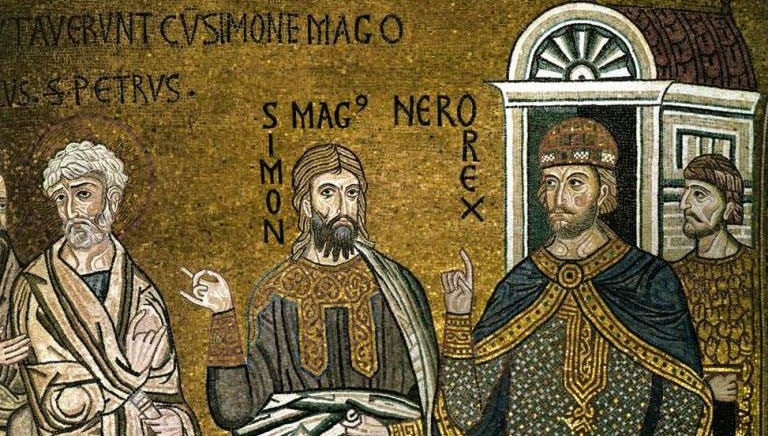
When Simon [the Sorcerer] saw that the Spirit was given at the laying on of the apostles’ hands, he offered them money and said, ‘Give me also this ability so that everyone on whom I lay my hands may receive the Holy Spirit.’ (Acts 8:18-19)
In a sense, our whole inquiry into mountain-moving thus far has been aimed at discerning the subtle but immense distinction between the spirit of Simon the Tanner and that of Simon the Sorcerer. You could say that the former is the spirit of Pentecost and the latter the spirit of Babel. Strangely enough, the same divine words, “nothing will be impossible,” were spoken over the people of Babel (Gen. 11:6) as over the disciples of Christ (Mat. 17:20). Yet, while the former was a blessing, the latter was a curse. Likewise, both Simons were wonder-workers—both even claimed faith in Christ—yet only one was praised as a saint, while the other was condemned.
Simon the Sorcerer very much believed in the signs the disciples were performing in the exact sense that Christians today typically understand belief. But when he offered Peter and John money to impart their gift onto him, their response was nothing short of devastating: “May your money perish with you!” (v. 20) What exactly was Simon’s error? He seems to have presumed that the impartation of the Spirit at Pentecost was the unveiling of a new power or technique, as though a new kind of Babel, when in fact it was something else entirely: not an ascent of men into the heavens in the form of a tower, but the heavens descending on men in the form of…what? Tongues. Language.
Recall that the people of Babel traded meaning for power and received the due penalty for their choice: a meaning crisis. As their power increased, the meaning of their words disintegrated. God’s punishment, the confusion of their language, far from being an arbitrary penalty for the sin of pride, was more like the sped-up natural consequence of their own foolish decision. The same pattern can be witnessed in the sorcerer’s famous word abracadabra. “Abracadabra” is a Babel word. Which is to say, it is not so much a word at all, not a meaning communicated to a subject, but a sound directed at an object. The sorcerer doesn’t know, doesn’t need to know, what “abracadabra” means. It doesn’t need to mean anything, because a spell is not a call; it’s a cause. With words like “abracadabra,” the sorcerer maintains a veneer of authority. He seems to be “commanding” his surroundings and his surroundings seem to “obey,” when in reality he has simply reduced himself to a hammer and the world around him to nails. It is a workaround. And it works, until it doesn’t. When meaning becomes only a means to power—when your yes is not truly yes—even the power you gain is lost in the end.
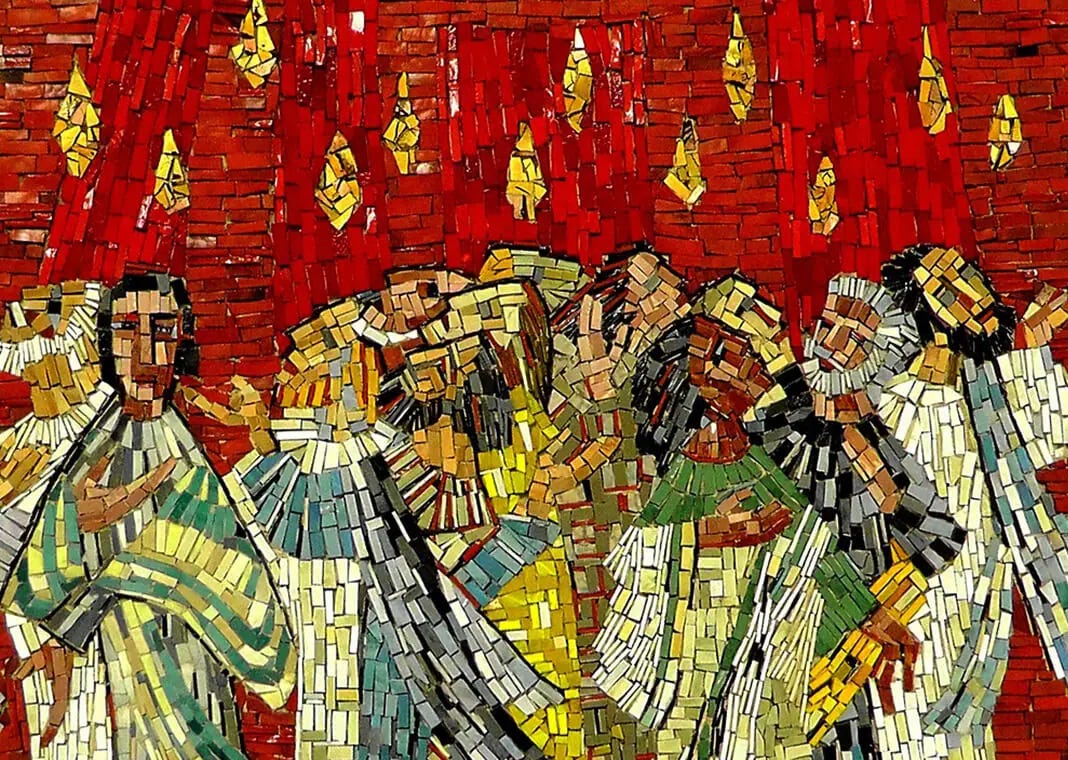
At Pentecost, however, the curse of Babel is redeemed.4 The upper room unveils a new, integrated language of Spirit and fire, which mends not only the divorce between differing languages, but the divorce inherent in language itself—between words and meaning, words and ears, words and bodies, words and world. Pentecost sews call and response back together again. It gives us, not the power to move things, like the sorcerer and the technologist, but the authority to speak in a way which allows all peoples and all things to hear and to move of their own accord, in proper response to the authoritative word. This is why the “tongues” spoken by the disciples in Acts 2 result not only in the comprehension of different peoples, but, ultimately, in those peoples’ repentance and salvation.
When the people heard this [Peter’s address after the pouring out of tongues], they were cut to the heart and said to Peter and the other apostles, ‘Brothers, what shall we do?’ (Acts 2:37)
If, at Christmas, the Word became flesh in Christ, at Pentecost, Christ’s words become flesh in us. And this fact becomes all the more significant when we recall that the Jewish Feast of Pentecost (Shavout) was originally the celebration of the giving of the Law:
Moses came and told the people all the words of the Lord and all the rules. And all the people answered with one voice and said, “All the words that the Lord has spoken we will do.” (Exodus 24:3)
The unveiling of the Law reveals again the true purpose of language, namely, incarnation: the integration of heaven and earth, word and deed, breath and dust—“what you have said we will do.” The pattern of the Law, like a schoolmaster, reintroduces the shape and grammar of the language of Eden (“Whatever the man called every living creature, that was its name”), which itself finds its root in the language of God (“‘Let there be light,’ and there was light”). But whereas the Exodus Pentecost fell short, the Acts Pentecost becomes its fulfillment. And the miracle of tongues becomes a key for understanding the form and function of all biblical miracles, as signs of the reconciliation of heaven and earth.
You can see now that the story of Simon the Tanner is a Pentecost story from beginning to end. Simon is a truly Pentecostal saint—not in the sense that he merely “believes in great signs” like Simon the Sorcerer, but in the sense that he has faithfully integrated the commands of Christ into his very body. His yes means yes and his no means no. He speaks the language of reality so clearly, even the mountains understand him and obey. Adam’s language—and with it, Adam’s authority—has been restored. And, just as on the day of Pentecost, Simon’s “gift of tongues,” leads ultimately to foreign peoples like the caliph hearing the call, repenting, and being baptized. Jesus spoke to the rock of the human heart through the voice of his servant Simon, and the rock gave way.
Language as Veil, Veil as Door
But how do we also receive this gift? There is perhaps no better symbol of the paradoxical union of holy simplicity and holy complexity in our everyday lives than the phenomenon of language itself. Human language is impossibly complex and almost infinite in its scope. It should be considered a miracle that any human could become a master of any mature language, and yet, each one of us wields our mother tongue with ease. How is this possible?
To be clear, complete mastery of a new language after childhood is like passing a camel through the eye of a needle. Nearly one hundred percent of adults will never fully master a language they did not speak as children. And yet, nearly one hundred percent of children, regardless of intellect, atmosphere, or industriousness, become masters of their mother tongue. The “gift of tongues,” in the most ordinary sense, is imparted to each one of us from the day of our birth. We don’t know where it came from or how exactly it works. We don’t invent a single word of it ourselves. There is no earning involved. And yet, we also don’t receive it automatically. Rather, the gift becomes more and more ours as we wield it, however imperfectly, and through participation, it is eventually perfected in us. I say “eventually,” but, in truth, it happens with shocking efficiency. A typical child achieves ninety percent mastery of his or her mother tongue by age five. “Slow is smooth, and smooth is fast.”
Why bring this up? Because the kingdom of God has its own language. You might even say, the kingdom of God is a language. Again, faith is not a mere belief or series of beliefs. Such a thing could never move a mountain. Faith is a language. In its mature form, it is the language of Adam, the language of Eden, the language of Pentecost. But, as with any language, we don’t become masters of it all at once. That’s not how language works, and furthermore, God does not zap. But he does know what he’s doing. Even the awkward stages of unfamiliarity have their purpose, if we let them.
The Twelve knew this discomfort all too well. On a certain bewildering occasion early in the Gospel of Mark, they asked Jesus why he spoke in parables. He answered like this:
To you has been given the secret of the kingdom of God, but for those outside everything is in parables, so that
‘they may indeed see but not perceive,
and may indeed hear but not understand’ (Mark 4:11-12a)
If you asked a thousand modern Christians why Jesus spoke in parables, 999 of them would surely say, “He used images from everyday life in order to make his teachings more clear and understandable for his audience.” But when Jesus is asked the same question, he says that he told parables to make things less clear. Not because he wanted no one to understand, but because the truth is often overwhelming, and the human heart is ill equipped to receive it. Thus, Jesus used his parables as veils, like the layered coverings of the tabernacle, encapsulating the truest truths for those inside, while simultaneously hiding and guarding those same truths from outsiders, those not yet ready to receive his message, lest, like Aaron’s sons, they harm themselves by entering too quickly into a world they have not properly discerned. Put another way, the parables of the kingdom are like a foreign tongue which reveals its secrets only to those who have stayed long enough to become fellow speakers.
Who, then, is “in” and who is “out?” At first glance, the idea of Jesus parsing insiders from outsiders with every parable he teaches (and miracle he performs, by the way) seems a bit harsh. The good news is that “inside” and “outside” in Scripture are not generally fixed categories, but movable distinctions. Holiness is for the sake of inclusion. As in the tabernacle, Jesus’s teachings and actions have layers upon layers of veils, which means that people can tend to be a little bit “in” and a little bit “out” at the same time. Like the blind man Jesus heals in Mark chapter 8, he can see a little when Jesus first touches him (“I see people, but they look like trees, walking”), but when Jesus touches him a second time, he sees more. The purpose of divine veils is the same in the New Testament as it was in the Old: incremental revelation for the sake of incremental healing. Veils become doors, one veil at a time, letting us “in” enough to relate to God where we stand, but not so far in, so fast, that we’re struck dead or dumb by his holy reality. Picture Moses at Sinai:
“Show me your glory.”
“You cannot see my face and live. But…I will put you in a cleft in the rock and cover you with my hand until I pass by..”
In the Gospels, the Twelve find themselves constantly on both sides of this inside/outside distinction. They are insiders in the sense that they “have been given the secret of the kingdom,” which is Christ himself. But they are also outsiders, since, even as they follow him and behold his mighty acts, they’re continually bewildered by his identity and purpose. Like travellers in a foreign country, they are learning to communicate in a strange tongue, one situation at a time. And language-learning is uncomfortably immersive. Foreign words are the only real way to learn a foreign language. How can one begin to speak and comprehend, except by slow and steady exposure to that which, at first, must only baffle and confuse? There is no way around the foreignness of the language of the kingdom of God; only through it.
This fact is especially hard for those who believe their own mother tongue will suffice to carry the load. They want their old wineskins to carry the new wine, but that’s not how it works. I know American expats who have lived in a Spanish-speaking nation for thirty years and still speak hardly a word of Spanish. They desire (and often think they have achieved) insider status, yet without ever becoming authentic insiders. They think they’re getting by just fine, but, in many respects, they don’t even know how and when they’re being shut out. Even when they do try to learn, they insist that every foreign word be translated back into their own familiar tongue. Yet the constant translation becomes the crutch that keeps them from walking freely, and the new wine of the new language is never fully tasted.5
By contrast, the child’s learning requires no translation at all. The words of his mother tongue enter his consciousness always in direct connection to that to which they refer: the word “dog” with an actual dog, the word “hug” with an actual hug, etc. The child learns not by translation, but by direct participation, and thus becomes a master not only of his parent’s language, but of meaning itself. New wine meets new wineskins. In this sense, a child’s language is very close to the language of Eden, where the name and the thing being named coexist in almost perfect unity. I believe it is by this holy residue from the Garden that we all first learn to speak. Truly, I say to you, unless you turn and become like little children, you will never learn the languages of earth, much less the language of heaven.
Of course, it’s easy to romanticize child-likeness, much harder to invite it upon oneself. There’s a reason small children are constantly crying. We’d rather not subject ourselves once more to the helpless frustration of a porous existence we cannot control. But, again, what if slow is smooth, and smooth is fast? What if we were to find, like Eustace in The Voyage of the Dawntreader, that the peeling off of our dragon scales by Aslan’s claws and being thrown into the healing pool “only smarted for a moment…and after that, the pain was gone?” Sure, but why all the pain? That wasn’t part of the evangelical advertisement. This salvation thing was supposed to be as good as done as soon as it began. “Be born again, and the kingdom of heaven is yours,” we thought. Instantaneous transformation, a one-stop salvation shop.
Yet that certainly isn’t what the disciples received, nor is it the pattern of the New Testament in general, with all its talk of suffering and perseverance. What if we were wrong? What if rebirth means exactly what it sounds like: becoming a baby again, with all its rather disturbing implications? If a mustard seed is like an infant being born, waiting to be fed, learning to live and perceive and communicate in fits and starts, well then, it might be terribly uncomfortable to be a mustard seed. The fact is, Jesus calls us to be born again, because he means to make us little children. And he means to make us children, not so that we would stay that way, but so that we can learn by participation to speak and act as mature sons and daughters of God, so that we can become, once for all, native speakers of his kingdom language. As with the Twelve, our Lord intends to bring us through every stage of growth until, in the end, we become like him. Or as St. Paul puts it:
until we all attain to the unity of the faith and of the knowledge of the Son of God, to mature adulthood, to the measure of the stature of the fullness of Christ, so that we may no longer be children… (Ephesians 4:13-14a)
For the Twelve, this process of maturity appears to have been a very slow and painful one. Yet, again, in retrospect, it happens quite fast. At first, they’re baffled by Jesus’s teachings. Eventually, they become teachers themselves. At first, they’re mystified by Jesus’s signs and wonders. Eventually, they perform signs and wonders just as he had done. At first, they’re scandalized by the very idea of his death. Eventually, they share in his death, taking up their own crosses, just as he had taught and foretold that they would. They’re confused and frustrated all along the way, nevertheless…they stay. “Lord, to whom else shall we go?” And because they stay, they do not merely behold Jesus doing great things; they do them. They become the temple of the Holy Spirit, the voice of Christ to creation, and the body of Christ in the world.
I’m not speaking theoretically here: they actually did it; and so must we. If we as baptized believers struggle to uphold this holy legacy, I submit that it is not primarily because the old Adam has more say than the new, but rather because we are still ungrown children in our Father’s house. And this alone is no cause for alarm. After all, the child’s babbles are the first signs of true speech, just as her stumbles are the first steps toward walking. Such babbles and stumbles, far from being concerning to a father and mother, are often beautiful in their own right. The concern comes, rather, when stumbles do not give way to walking and broken language does not give way to speech. When development slows to a stop, further questions must be asked.
The Permanence of Holiness
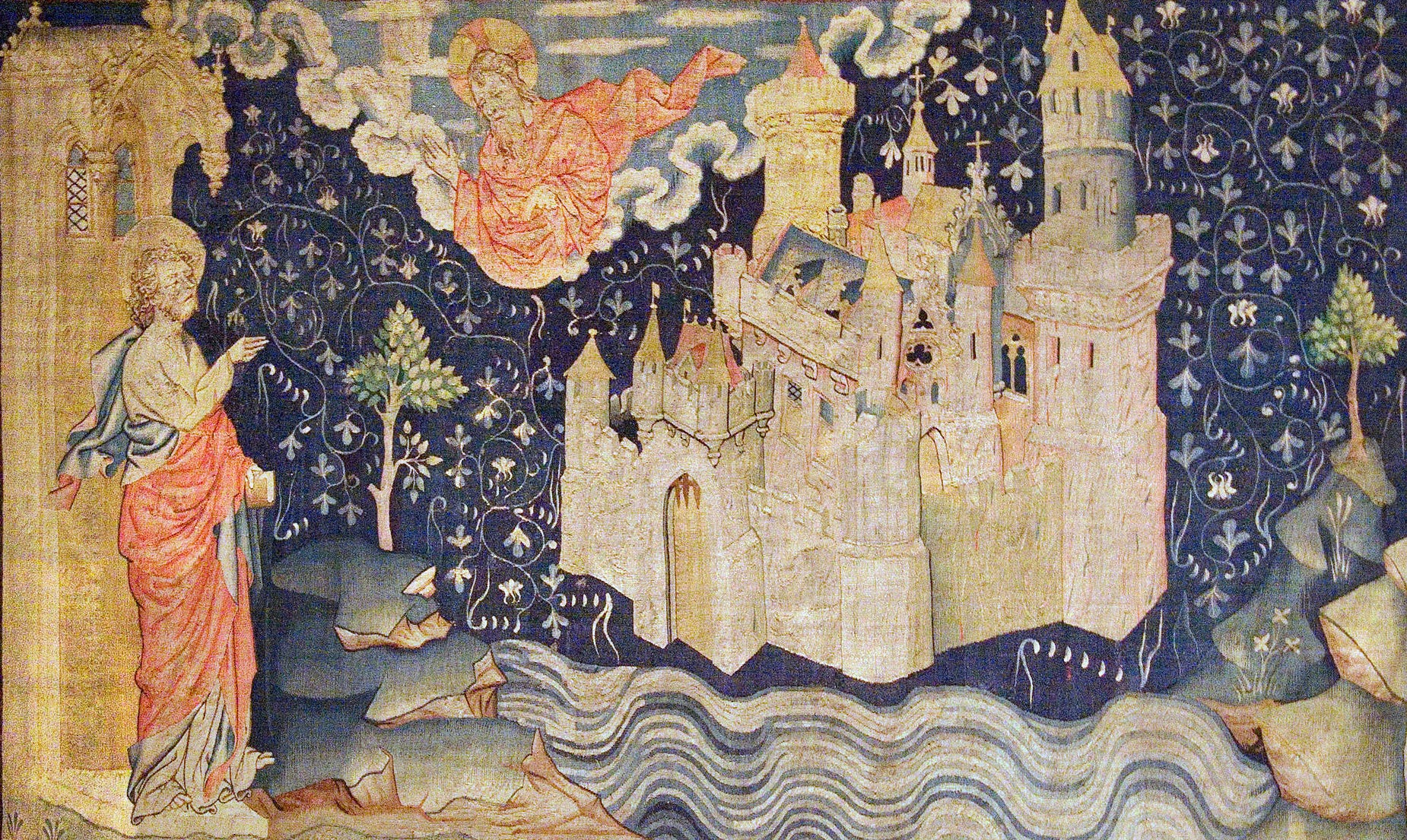
For most of this essay, I’ve referred to the language of faith as the language of Eden, but that wasn’t quite right. The language of the Christian faith is more precisely the language of the New Jerusalem. This is the tongue that moves mountains and woos hearts, which we are learning to speak to prepare ourselves for eternity. But how can we be expected to learn to speak it now, in this fallen world? A friend once asked me a similar question, but from the opposite side: “In the New Jerusalem,” he said, “when all things are made new, a new heaven and a new earth, assumedly we will still have free will, so isn’t it possible that there could be another fall? If Eden were perfect and we sinned, then why couldn’t the same thing happen again? How are we not somehow destined for an everlasting cycle of fall, redemption, fall, redemption?”6
It’s a difficult question, but I think the word “perfect” holds the key. In modern usage, “perfect” tends to mean “flawless.” The perfect machine, for instance, would produce the same outcome in the same way again and again. Thus, “perfectionism” in human beings is generally seen as unhealthy, since humans are not machines. Not only is it unrealistic to expect ourselves to produce the same flawless outcome in any and every situation, it might not even be desirable if we could. To make matters worse, this same modern notion of perfection—as mechanistic homogeneity—has seeped into our view of eternity. More than a few times I’ve heard the rebuttal, “I’m not sure I would want heaven to be perfect. Wouldn’t that get boring? Everything and everyone acting in exactly the same way. No surprises. Nothing new. That doesn’t sound like paradise at all.” Indeed, that kind of heavenly “perfection” sounds more like a nightmare. Yet the problem is not with heaven itself, but with our notion of perfection.
For the writers of the Bible—and for most humans throughout history—the word “perfect” had to do with finished-ness, not flawlessness. Something was called “perfect” when it was brought to its full maturity, when it became everything it was meant to be. Now, if we apply this definition to the Garden of Eden, we would have to conclude that Eden was not perfect. Rather, Eden was good, as Genesis tells us over and over. He created this and that, and it was good. He created human beings, and it was very good. But it doesn’t say perfect. In a very important sense, it was not yet perfect, because it was not yet complete. Eden was only the beginning. The garden was a young place, a place of potential, like a seed. God gave Adam and Eve things to do there. He told them to name the animals, to have dominion, to be fruitful and multiply, and, of course, to refrain from eating of a certain tree of knowledge. These commands set the stage and tilled the soil, so that each relationship—with him, with one another, and with creation—could bear fruit, could become stronger and deeper and wider over time. In other words, God made a place for love to grow, a sanctuary for maturation and, ultimately, theosis.
Adam and Eve had everything they needed, yet still they were destined for more. Though they were sinless, there was still much they had not and could not yet experience, gifts they were destined to receive but could not receive, not because God was unwilling to give them, but because they were not yet mature enough to receive and enjoy them. If they had only continued to walk with God, they would have beheld themselves and the world around them blooming into unimaginable glory. Instead they took the thing they were meant to wait for, and that thing became a curse rather than a blessing. This is the tragedy of Eden. But the New Jerusalem promises something far greater than Eden ever was: not just a return to Eden, but Eden redeemed and completed—men and women and all creation reaching full maturity in Love.
I believe this is what Jesus meant when he taught his disciples, “Be perfect, therefore, as your Father in heaven is perfect.” That is, do not aim to be flawless—the most fruitful trees have a thousand scars—instead, aim to be finished. He made us to be priests and saints of God; he is remaking us with the same end in mind.
I’m aware that this defies our ready-made culture and many of our ready-made notions of the gospel. But as the story of the Bible (and the story of our lives) slowly and painfully reveals, no such salvation is on offer. Even if it were, it wouldn’t be a true one. If, for instance, by the sudden flip of a switch or wave of a wand, all creation were put right, what a fragile paradise that would be, prone to another fall and then another. Yet the Bible’s vision of the New Jerusalem is different. The twenty-four elders do not automatically find themselves in alignment with their king. No, they fall down of their own accord, casting their crowns before the throne, offering up their own power and glory back to him, just as he had first offered up his for them.
The saints of the New Jerusalem are not magically flawless; they are faithfully finished. They cannot fall again any more than an adult could suddenly become an infant again. They cannot hate what their hearts have learned to love, nor love what their hearts have learned to hate. They cannot unlearn the language of the kingdom of God once it has become their native tongue. There is no going back. Perfection-as-flipped-switch would be fragile, but perfection-as-maturity can never be undone. It can only grow more and more perfect through all eternity. The latter glory of the city is greater than the former glory of the garden, in part, because it has become all the more permanent.
Conclusion
Can mountains really be moved? Perhaps it’s easy enough to believe they can be. I believe Simon the Tanner did. But that is not what faith requires. Past gospels and future gospels are always easy to believe. The hard thing, and perhaps the most vital thing, is to believe that right now his Spirit is transforming us into his image by participation in his life, death, and resurrection. For the Christian, these are more than mere facts. It is easy to believe the fact that trees grow from seeds. It is much harder to plant a seed and actually watch it become a tree. The only way to know the truth is to become as rooted as the tree itself: to stay and wait and behold. In the end, it will have happened sooner than you think. I tell you the truth, the kingdom of heaven is like a grain of mustard seed that a man took and sowed in his field. It is the smallest of all seeds, but when it has grown…
Lord, we are children born into a house of mountain-movers, too young to claim our inheritance and yet not young enough to grow. Turn our words to babble and our babble to words. Speak to us as your little ones, so that we can learn to speak like you. So that our yes can soon be yes, and our no, no. So that our words, first in prayer to you, then to the world around us, will not return to us void, but achieve the purpose for which they were sent. Speak to the mountain in us, so that we can move mountains too. Amen.
Many thanks to A. A. Kostas and Griffin Gooch for the advice on this one. If you enjoyed this post, please hit the LIKE and RESTACK buttons below. Thanks!
cf. Owen Barfield’s concept of “original participation.”
Jerry Bridges, Respectable Sins, p. 3
“Just as he who called you is holy, you also must be holy in all your conduct, since it is written, ‘You shall be holy, for I am holy’” (1 Peter 1:15-16).
Pentecost is the reverse-Babel, not in the sense that it reduces the diverse languages of the nations back to one, but in the sense that it redeems and unifies those languages under one meaning—one translation of all—namely, incarnation. As Malcolm Guite notes in his comments on Lancelot Andrewes’ Pentecostal theology: “for God himself has already made, and risked, the greatest translation of all, when the Word was made flesh.” (h/t Griffin Gooch)
Note the beautiful irony of the mockers’ comment at Pentecost: “They are filled with new wine.” (Acts 2:13)
Bits of this section are taken from an essay I wrote for Mere Orthodoxy entitled, “Be Perfect.” Since the beginning of this project, I’ve had that thesis in mind.