


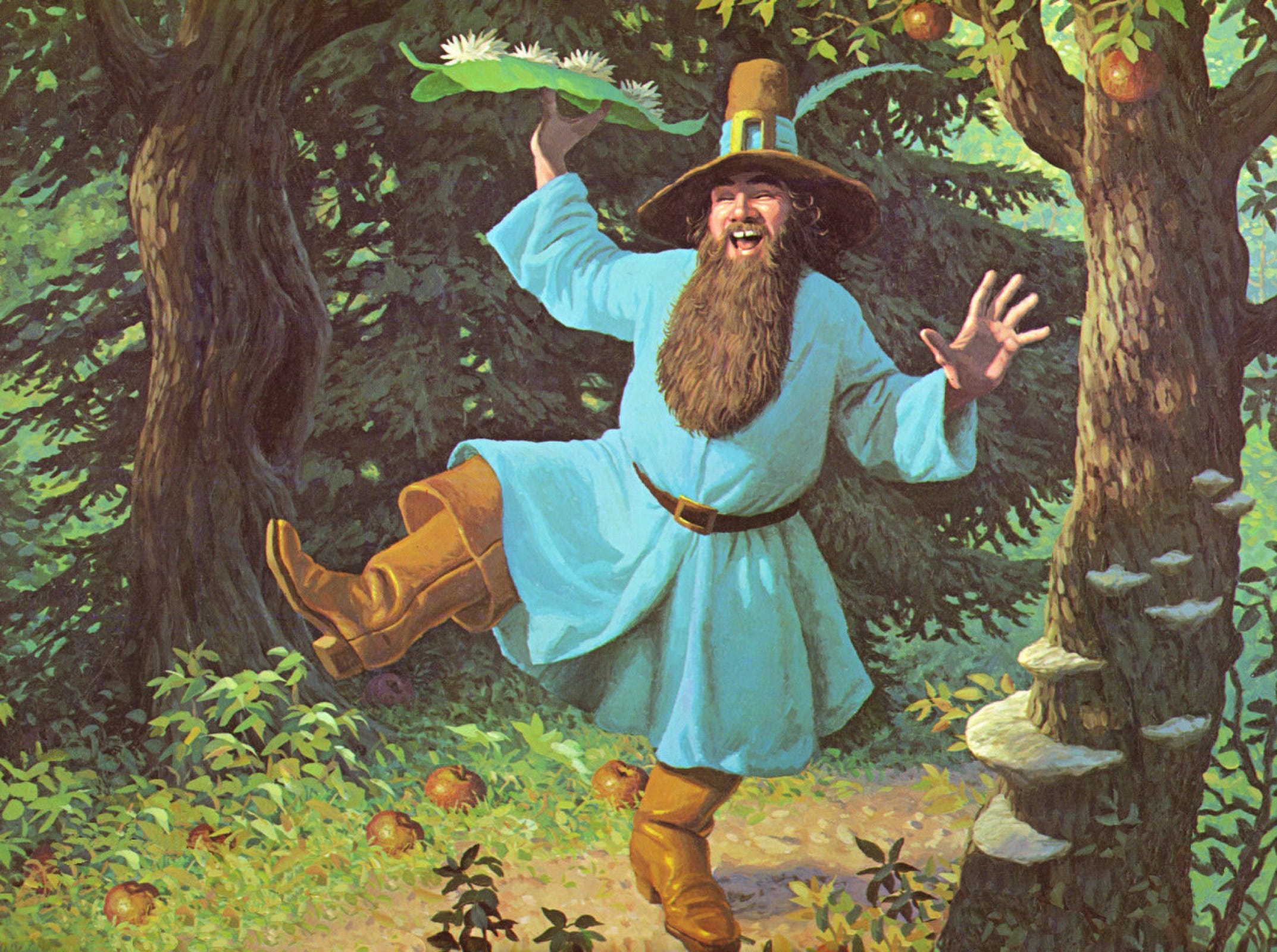
Old Tom Bombadil is a merry fellow,
Bright blue his jacket is, and his boots are yellow.
None has ever caught him yet, for Tom, he is the master:
His songs are stronger songs, and his feet are faster.
Intro: Magic or Mastery?
As I begin this third installment of my essay series on moving mountains (check out Part 1 and Part 2 if you haven’t yet), I’m trying to fight the nagging fear that some might judge this to be the most annoying of the three. At the close of my last essay, I posed a question:
What would it look like to be trustworthy to a mountain for long enough to change its mind so that it wants to respond to our call? How can we begin to remake our lordship into love so that it can finally become true lordship? I have some ideas.
Indeed, I have one idea in particular. But—here’s where the annoying part comes in—my idea is not exactly a packageable solution. You could not apply it today and be impressed with how well it’s working tomorrow. If it ‘works’ at all, it works like a mustard seed becomes a tree. And so the best way I know how to communicate it is to begin to paint a picture, or series of pictures, of how a tree grows, in hopes that that picture becomes a path and that path takes us toward the solution we seek.
Of course, I understand the frustration of those who already feel like this series needs to “get to the point.” I feel it myself. But if the question at the heart of this study is, “How might we (literally) move mountains?” the answer doesn’t lend itself to a quick summary, nor to a quick anything. Jesus did not train sorcerers, but sons. And sons (and daughters) must first stumble through the awkward and unfit stages of infancy and adolescence before their inheritance can be rightly realized.
St. Francis, we’ve been told, commanded birds and fish and wolves in much the same way that Jesus commanded the storm. How did he do it? And how can we follow in his footsteps? The idea that drives these final two essays is that Christian miracles are not what we often think. In particular, they are less like magic and more like mastery.
I don’t mean scientific mastery exactly, at least not the kind that has built our modern machines. Today’s technologists have more in common with yesterday’s alchemists than they might care to acknowledge. Even their ‘mastery’ is more like that of the magician than the proper scientist.1 Nor by mastery do I mean the kind of spiritual techniques that drive the “name-it-and-claim-it” side of charismatic Christian culture. Such charismatics are perhaps most in agreement with my general premise, that we can move mountains with a mustard seed of faith. Amen. Yet that very belief has sent many down the short road of spiritual power rather than the longer, more arduous path of authority and mastery.
I tell you the truth, the kingdom of heaven is like a musical instrument which few have the patience to play, not because it is impossibly hard, but because it is the kind of instrument that takes nothing less than a lifetime to learn. But to the one who keeps playing and does not stop, it will produce a song unlike any that has ever been heard in the history of the world. Many will try to play it, but few will hear its song.
Andy Crouch has argued that the central project of our cultural moment is to replace instruments (which require patient mastery over time) with devices (which give us what we want when we want it). Andy was talking about literal technologies, but I suspect the same can be said of our contemporary spirituality. We want an experience of God, and we want it now. This is why many of our evangelical and charismatic worship services—and even more of our popular worship music—appeal to a pattern that resembles that of Simon the Sorcerer much more than the Persistent Widow.
Technological and spiritual devices play the role of the genie. What the genie gives, he gives immediately, obviously, automatically. What he takes, he takes slowly, incrementally, and almost imperceptibly. That is the hidden bargain we make with our favorite wish-granters.
Mastery, on the other hand, works in almost exactly the opposite manner. What it takes is obvious from the start: nothing less than your immediate, consistent, embodied devotion. But what it gives, it gives slowly, subtly, and most of all, sustainably.
St. Francis understood—and more importantly embodied—this kind of mastery. He fulfilled his role as a cosmic middleman, forging relationships of trust and trustworthiness with God above and creation below. And the immediate result, perhaps, was that more birds followed him than people. But that didn’t last long. Within only a few years, his influence surpassed that of many popes and kings combined. Mastery is slow. But as my Navy Seal friends say, “Slow is smooth, and smooth is fast.”
The Tortoise And The Hare
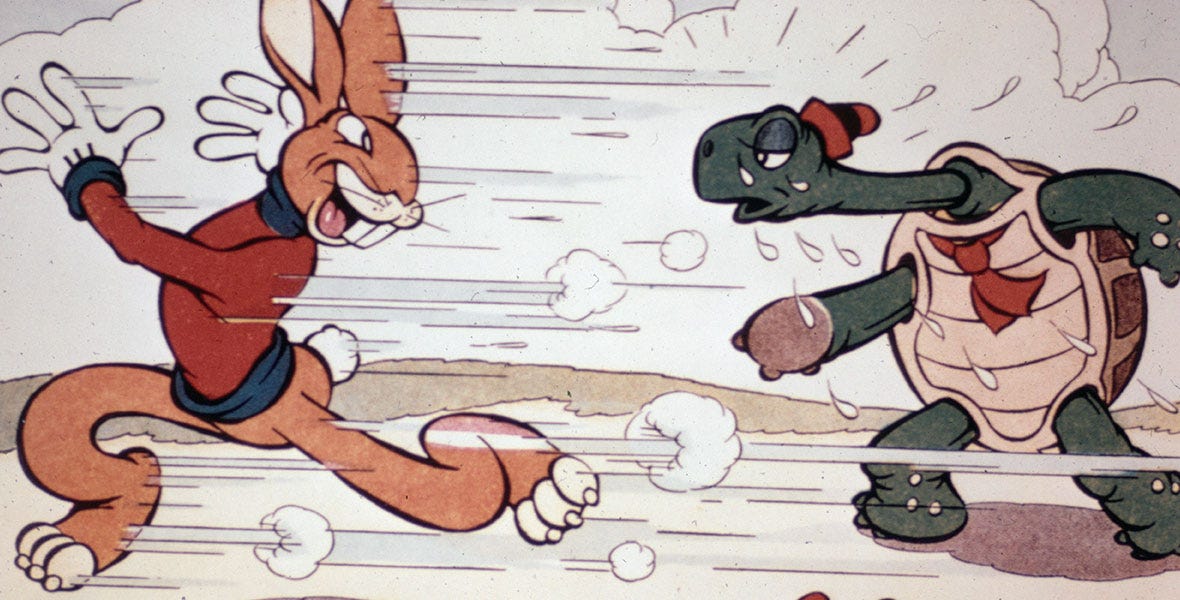
The thesis of this series is that God works primarily according to the subtle economy of call-and-response and only secondarily according to the more obvious economy of cause-and-effect, and that human beings were meant to do the same. The physics of heaven is authority: “Let there be light,” which governs the physics of earth: “And there was light.” My claim is a simple one: Call-and-response is what actually rules the world. Call-and-response governs cause-and-effect. This is how everything works. This is why life is beautiful. This is why love is real. But this is also why our world and our own hearts remain so tragically un-redeemed, even after the Redeemer has come and conquered.
Our Lord said it himself: his kingdom is not of this world. It operates according to a different principle. Cause-and-effect is automatic, like pushing a button on a device, like Newton’s Third Law of Motion. But call-and-response is not. For every action, there is not an equal and opposite reaction. It does ‘work’—his word does not return to him void—but it doesn’t work in straight lines. Christ’s “conquest” of Rome took three hundred years longer than his disciples were hoping for and required only one major act of force: his enemies nailing him to a tree. The kingdom of call-and-response is a long-game. Authority is the tortoise, and power is the hare. The tortoise is winning, and he will certainly win in the end. But his victory may look like defeat all the way up to the finish line.
Moreover, believing in such a kingdom (even a little bit) is no small thing. It’s like putting your money on the tortoise as you watch the hare blow past him. Why would anyone ever make such a bet? Of course, most of us don’t. Most of us bet on the hare, the way of power. And we choose it because, most of the time, it works. Power is a pretty straightforward deal. When Moses strikes the rock instead of speaking to it as the Lord had commanded, it still produces water for the people. When Adam and Eve take the fruit from the forbidden tree, it still feeds them and gives them knowledge. Only later do they find, in each case, that their methods cost them the Promised Land.
It is my contention that much of our contemporary world is operating according to a similar protocol. We are striking the rock, stealing the fruit, betting on the hare, and enjoying our victory all the way up to the moment of defeat. We are suckers for push-button solutions to deeply non-push-button problems, because, again, they seem to work. And also because, though our hearts yearn to be something like married to the good world that God gave us—yes, even to its storms and sea monsters2—we are neither patient enough nor courageous enough to commit ourselves to that union. So we settle for a kind of profitable promiscuity, which pays the bills without “tying us down.” And the water we force from the rock and the fruit we steal from the tree tastes…fine. It almost satiates.
But let’s say you did bet on the tortoise. What would that be like? Well, it would be like losing, for a long time, before you win. Like reorienting yourself toward the patient mastery of a much longer race, fixing your eyes on a finish line you cannot even see. This is the way of faith. This is the way of authority. And I think it’s the way mountains are moved. Call-and-response is a long-game compared to cause-and-effect. But it might not take as long as you think. Again, slow is smooth, and smooth is fast.
Come In, She Said, I’ll Give Ya…Diapers For The Storm
And they woke him and said to him, “Teacher, do you not care that we are perishing?” And he awoke and rebuked the wind and said to the sea, “Peace. Be still.” And the wind ceased, and there was a great calm. He said to them, “Why are you so afraid? Have you still no faith?” And they were filled with great fear and said to one another, “Who then is this, that even the wind and the sea obey him?” (Mark 4:38-41)
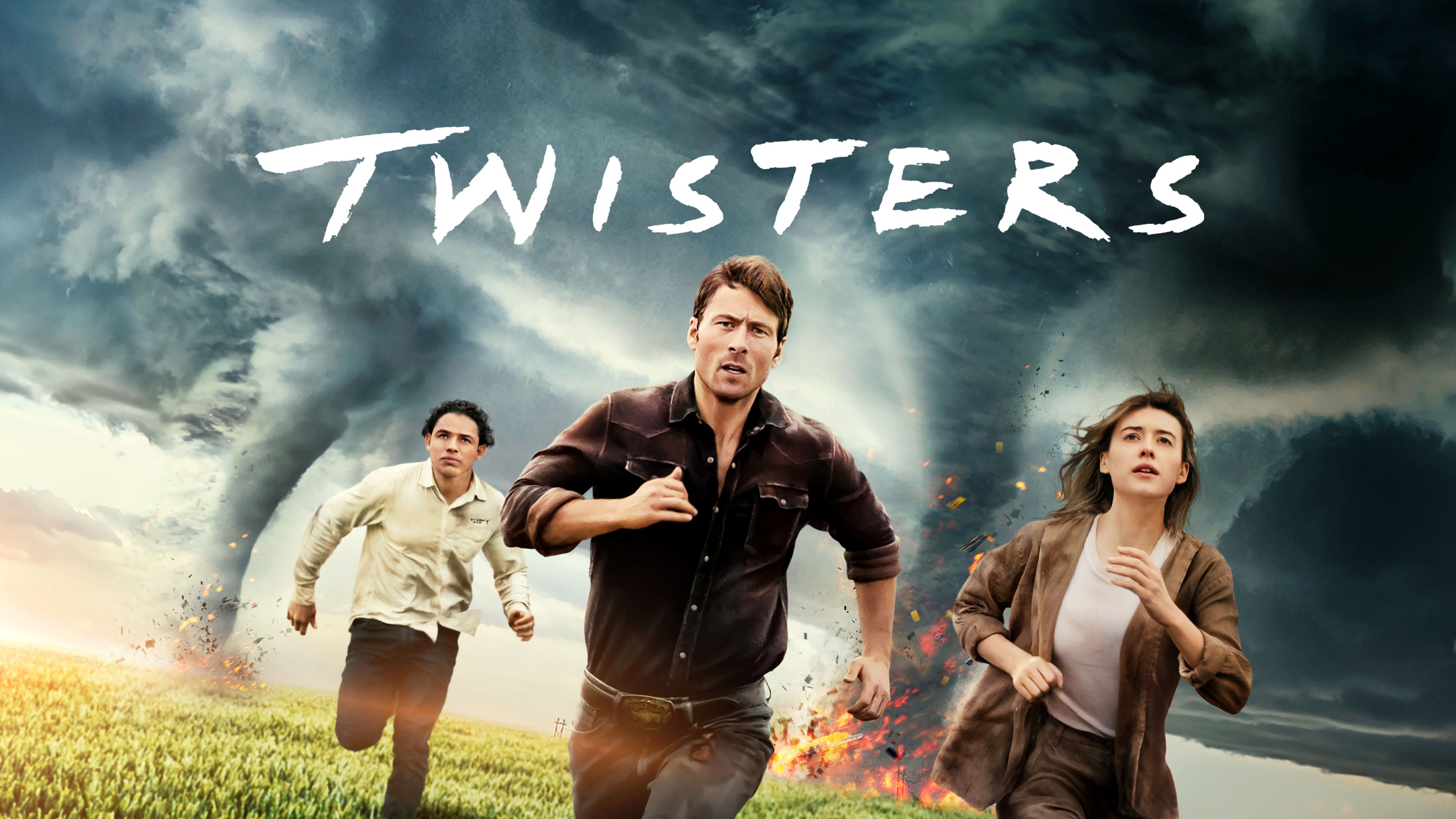
Last year’s blockbuster Twisters was not a bad film. As the follow-up to Helen Hunt and Bill Paxton’s 1996 thriller Twister, of which little-kid-Ross was a big fan, the sequel delivered a similar plot and spirit, though with one major difference, which bothered me more, the more I thought about it.
Both movies focus on two courageous storm-chasing scientists, a man and a woman, who put themselves in the path of massive tornadoes to see how they work, in hopes of saving future lives. Both pairs are haunted by tragic backstories thanks to the monsters they now chase. Both pairs are faced with the strange necessity to get up-close-and-personal with the beautiful and deadly unknown, whether it be a city-swallowing tornado or their possibly-romantic counterpart. Both movies are ultimately about communion.
But whereas in the original story, the aim is to get close enough to the storms to gain deeper knowledge (for the development of better warning systems), in the sequel, the protagonist Kate has a different, more impatient plan. She has invented a means of overpowering tornadoes by shooting super-absorbent polymers—the stuff diapers are made of—into the cyclone in order to suck the moisture out, forcing the storm to collapse. In short, she doesn’t want to know the tornados so much as to kill them.
Thankfully, this strange tension between killing and communion is soon resolved in the person of Kate’s romantic prospect, Tyler, who not only saves the day but, in my opinion, saves the film. Tyler (played by Glen Powell) is an intelligent, thrill-seeking redneck who actually does still chase twisters for the awe and wonder of it. Despite his coarse exterior, Tyler represents a more patient relationship with the storms they’re chasing: “It’s part science and part religion…When you love something, you spend your whole life trying to understand it.” One could almost imagine him speaking to the storm and the storm listening.
At first, Kate thinks Tyler is an idiot, but eventually his partnership—and rare ability to put himself right in the middle of these cyclones—helps her to reclaim not only her initial love for the storms but also, more importantly, her love of the people and place she left behind (for a fancy desk job in New York City of all places) after a traumatic experience with a twister years earlier.
All this doesn’t exactly derail Kate’s mission to kill the beast that killed her friends—the polymers work in the end—but by the grace of God the filmmakers seemed to intuit that tornado-diapering alone would hardly suffice as a compelling conclusion. So, in the penultimate scene, as in the original film, the lovebirds are forced into the heart of the storm where together they behold and admire its beauty and wrath. And this gives them the courage to behold the mysterious beauty they see and fear in one another. Love, after all, is not a storm you can simply kill from a distance, but which must overtake and almost consume you like a twister before you can see exactly what it is and what it’s worth.
By now, you can probably see where I’m going with this. From a Christian perspective, there are two ways to calm a storm: you can force it, as Kate does in Twisters, or you can speak to it, as Christ does in the Gospels. The first has to do with power or cause-and-effect; the second has to do with authority or call-and-response. Understanding the difference between the two may ultimately frame what you think the Christian life is, and is for. But again, what kind of person could speak to a storm, and how would one learn to do so?
The Playful Authority of Tom Bombadil
I mentioned J. R. R. Tolkien’s Lord of the Rings once already in this series. Imagine, I said, that not unlike Sauron forging the one Ring of Power in order to enslave all the races of Middle Earth, God gave to Adam and Eve a kind of “ring of authority” by which they were meant to lead and guide the created order into further and deeper love and faith and glory. But that ring, too, was lost. The dominion of Adam was corrupted.
What I didn’t mention then was that I think Tolkien also had this notion on his mind, this curious distinction between power and authority. His clearest depiction of it is in the character of Tom Bombadil, who, in my view, seems to possess the very ring of authority I’m talking about.
The Lord of the Rings, as anyone will tell you, is a story of good versus evil. But more specifically, it’s a story about the problem of power, about how power can corrupt even the best men who wield it uncarefully, and about how something more than power is required if goodness is to win in the end. But what? Courage, hope, faith, and loyalty might all be suitable answers, judging from the main characters of the story, who, armed with such virtues as these, defend Middle Earth from the rule of Sauron. Yet in the early chapters of Tolkien’s epic, we meet another figure, who represents a different—and, I think, even deeper—answer to this question.
Tom Bombadil is the oldest living being in Middle Earth. The hobbits first meet him in the Old Forest, when he stumbles almost haphazardly upon their dire encounter with Old Man Willow, who has swallowed Merry and Pippin into his trunk. At the height of their desperation, Frodo hears the faint sound of a man singing nonsense in the distance:
Hey dol! merry dol! ring a dong dillo!
Ring a dong! hop along! fal lal the willow!
Tom Bom, jolly Tom, Tom Bombadillo!
This is how we meet the oldest and most ‘powerful’ being in all of Middle Earth.
Frodo and Sam stood as if enchanted. The wind puffed out. The leaves hung silently again on stiff branches. There was another burst of song, and then suddenly, hopping and dancing along the path, there appeared above the reeds an old battered hat with a tall crown and a long blue feather stuck in the band. With another hop and a bound there came into view a man, or so it seemed. At any rate he was too large and heavy for a hobbit, if not quite tall enough for one of the Big People, though he made noise enough for one, stumping along with great yellow boots on his thick legs, and charging through grass and rushes like a cow going down to drink. He had a blue coat and a long brown beard; his eyes were blue and bright, and his face was red as a ripe apple, but creased into a hundred wrinkles of laughter. In his hands he carried on a large leaf as on a tray a small pile of white water-lilies. [...]
‘My friends are caught in the willow-tree,’ cried Frodo breathlessly.
‘What?’ shouted Tom Bombadil, leaping up in the air. ‘Old Man Willow? Naught worse than that, eh? That can soon be mended. I know the tune for him.’
Keep in mind, the hobbits had been fighting for their lives. Just moments before, they had tried to set the tree on fire, but that had only made things worse. And yet Tom immediately ‘knows the tune for him’. Without the slightest change in his whimsical tone, he sings to the ancient tree, and at once it lets Merry and Pippin go. Tom then invites the hobbits back to his home, where they learn more about their mysterious rescuer.
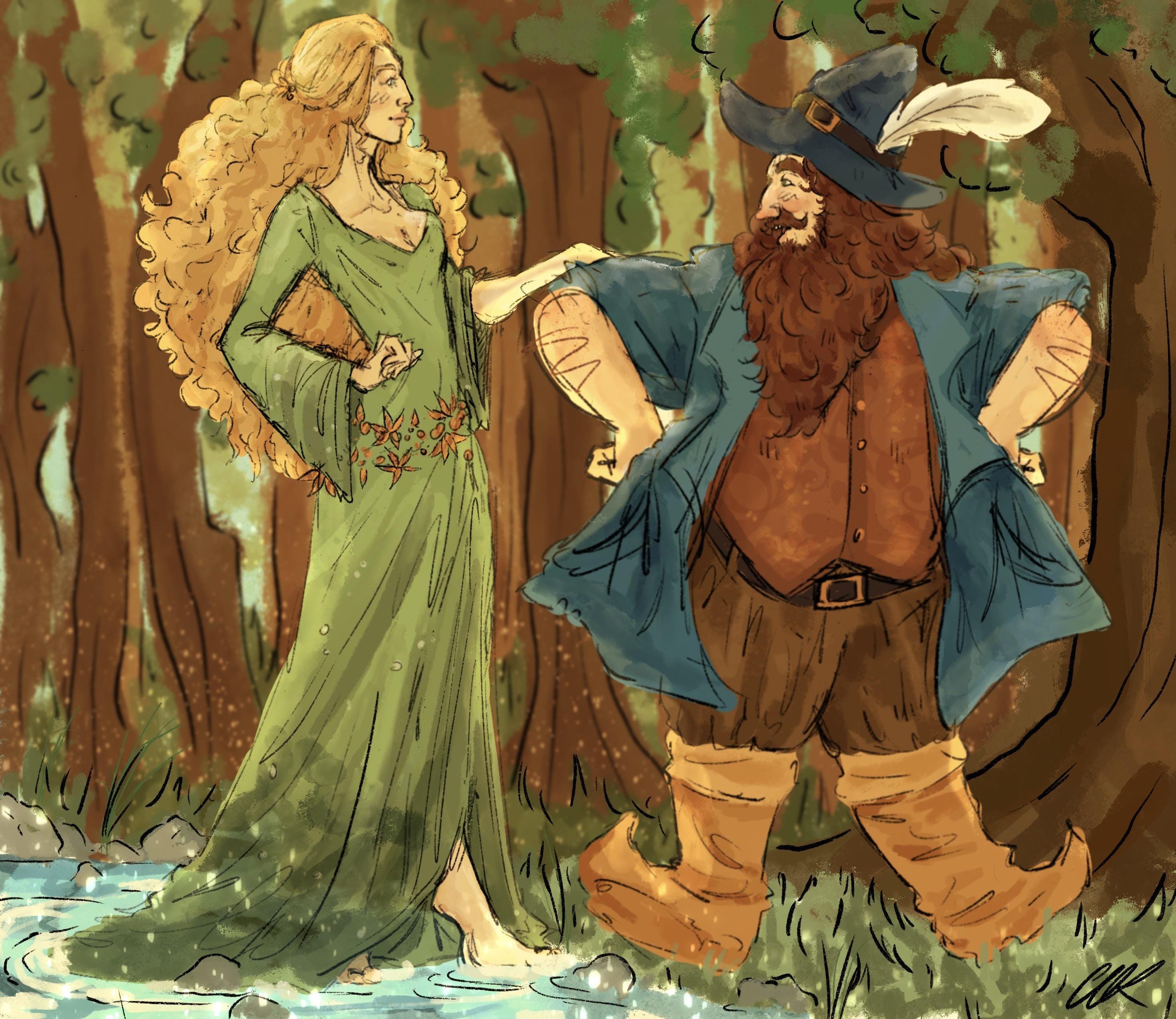
‘Fair lady!’ said Frodo [speaking to his wife, Goldberry], ‘Who is Tom Bombadil?’
‘He is,’ said Goldberry, staying her swift movements and smiling.
Frodo looked at her questioningly.
‘He is, as you have seen him,’ she said in answer to his look. ‘He is the Master of wood, water, and hill.’
‘Then all this strange land belongs to him?’
‘No indeed!’ she answered, and her smile faded. ‘That would indeed be a burden,’ she added in a low voice, as if to herself. ‘The trees and the grasses and all things growing or living in the land belong each to themselves. Tom Bombadil is the Master. No one has ever caught old Tom walking in the forest, wading in the water, leaping on the hill-tops under light and shadow. He has no fear. Tom Bombadil is master.’
The trees and grasses and creatures of the wood belong to themselves, she says—that is, they have their own agency, their own undisturbed purposes, their own life and existence—but Tom is the master. He has no interest in power, and yet he rules the whole forest realm. How? By his songs. By his words. By his playful authority, to which even the most hardened and powerful creatures of the forest submit without question.
Later that night, the hobbits tell Tom the tale of their journey thus far—of Gandalf, of the Black Riders, and even of the ring.
‘Show me the precious Ring!’ [Tom] said suddenly in the midst of the story: and Frodo, to his own astonishment, drew out the chain from his pocket, and unfastening the Ring handed it at once to Tom. It seemed to grow larger as it lay for a moment on his big brown-skinned hand. Then suddenly he put it to his eye and laughed. For a second the hobbits had a vision, both comical and alarming, of his bright blue eye gleaming through a circle of gold. Then Tom put the Ring round the end of his little finger and held it up to the candlelight. For a moment the hobbits noticed nothing strange about this. Then they gasped. There was no sign of Tom disappearing! Tom laughed again, and then he spun the Ring in the air – and it vanished with a flash. Frodo gave a cry – and Tom leaned forward and handed it back to him with a smile.
The depth of foresight required to include such a careless and comical figure as Tom Bombadil so near the beginning of an otherwise quite dark and treacherous quest seems to surpass even Tolkien’s own ingenious machinations. I really think it might be the most important tangent in all of modern story-telling. Yet, at first glance, it seems like a terrible idea. With respect to the story as a whole, Tom appears as an almost cartoonish shock to the system, a jarring aside, too definitively early in the story to pass for a mere tangent, and yet too disconnected from the rest of the narrative to justify its central position. It’s the sort of episode any good editor would tell you to cut. Peter Jackson did cut it from his film adaptations, though out of respect, not disdain. Yet one can hardly imagine how it would have played to include Tom in the movies.
Tolkien himself is far from denying the incongruity. If anything, he overstates it in Letter #144:
Tom Bombadil is not an important person – to the narrative. I suppose he has some importance as a ‘comment’. [...] He represents something that I feel important, though I would not be prepared to analyze the feeling precisely. I would not, however, have left him in, if he did not have some kind of function.
But what is that function? I think we can begin to see it if we consider the impression the Peter Jackson movies left without Tom Bombadil ever gracing the screen. The films, in my view, are a masterpiece. However, without Tom, they do come dangerously close to convincing us that the struggle for Middle Earth is primarily a struggle between good power and bad power, which was never Tolkien’s objective.
The ring doesn’t represent “bad power” so much as power itself. Like the devil’s temptation of Christ in the wilderness—“I will give you all the kingdoms of the world. Only bow to me,”—the ring makes power primary. That is its trap. Straight-line power becomes the master, when it was meant to be a servant. Christ would claim the kingdoms of the world as his own, but not by such means. Likewise, the Fellowship must trust not in the Ring of Power itself to defeat Sauron, but in the unlikely success of a defenseless hobbit zig-zagging his way across Middle Earth and into the adder’s den.
In other words, the Fellowship bets everything on the tortoise. And yes, Aragorn and Gandalf do use good power against bad power to protect the hobbits on that journey (and to protect the kingdoms of men from utter ruin). But they understand that such battles are only secondary affairs, that all of it will have meant nothing if Frodo and Sam are unable to sacrifice the ring—to “give it back” to the fire from which it came—just as Tom Bombadil had so effortlessly given it back to Frodo at the beginning of their quest. In this way, Tolkien cleverly gives us a picture of the end of the quest at the beginning. Tom is Frodo’s plausibility structure for doing the impossible.
After leaving Bombadil’s home, the hobbits soon find themselves in another deadly impasse, this time in the hands of a barrow wight (an evil spirit of the tombs), who has captured and cast a spell on them with its own cold song. But just before the end, Frodo remembers what Tom taught them: not some great power of self-defense, but a call for help, a song.
In a small desperate voice he began: ‘Ho! Tom Bombadil!’ and with that name his voice seemed to grow strong: it had a full and lively sound, and the dark chamber echoed as if to drum and trumpet.
Ho! Tom Bombadil, Tom Bombadillo!
By water, wood and hill, by the reed and willow,
By fire, sun and moon, harken now and hear us!
Come, Tom Bombadil, for our need is near us!
There was a sudden deep silence, in which Frodo could hear his heart beating. After a long slow moment he heard plain, but far away, as if it was coming down through the ground or through thick walls, an answering voice singing:
Old Tom Bombadil is a merry fellow,
Bright blue his jacket is, and his boots are yellow.
None has ever caught him yet, for Tom, he is the master:
His songs are stronger songs, and his feet are faster.
Frodo’s song is an image of childlike prayer. Not perhaps the sort that can move mountains (yet), but at least the sort that has come to believe that mountains can be moved by the one who has authority to do so. Notice the play between slow and fast. There is a long, slow moment in which Tom seems nowhere in sight. Then he appears, singing of his victory, “His songs are stronger and his feet are faster.” Tom’s authority is not like the power of the barrow wight, not even like Gandalf’s magic. He is older and more patient than Gandalf, more patient even than death itself. After Tom sings away the demon, he and Frodo carry the unconscious hobbits out of the tomb and lay them down, still as death, on the ground. Tom sings again, and the hobbits wake to new life. Even death bends its ear to the master’s song.
This is our last encounter with Tom Bombadil. The rest of the narrative will be driven by clever plans and courageous deeds. Wizards and warriors will arm themselves and expend their strength in the great battle against the Dark Lord. And it will not have been in vain. But neither will it have been the main event, since, all the time, the secret to Sauron’s destruction lay in the tiny hands of a hobbit from the Shire.
And what is that secret? Not the ring itself. No, the secret is rather the knowledge that the ring is not the secret. The secret is a mustard seed of faith, a growing hope that a word or a song really can drive out the darkness and raise the dead to life. Faith enough to lay the ring down, or else to do something even more impossible: to carry it and guard it and fight to hold onto it for just long enough to let it go forever. Perhaps not even Bombadil could or would have done such a thing himself. Perhaps Gandalf was right that Tom would have only misplaced the ring or thrown it away, since he cared so little for power.
Either way, I think it was Tom who first showed Frodo what a mustard seed of faith could do, by teaching him to sing a joyful song in the black of the tomb. In that moment, Frodo became not the master, but at least the master’s apprentice. The song was not yet his own, but at least he had learned to sing it.
Unfortunately, the ring did not then become lighter for Frodo, as it had been for Tom. Nor could Tom carry the burden that was his alone to carry. Nevertheless, Frodo had tasted and submitted himself to the playful authority of Tom Bombadil. And in doing so, he had come to know something of the subtler physics of Middle Earth, which few beside him would ever see so clearly.
‘Hey! Come Frodo, there! [said Tom, after Frodo had put on the ring, thinking himself invisible to all in Tom’s house]. Where be you a-going? Old Tom Bombadil’s not as blind as that yet. Take off your golden ring! Your hand’s more fair without it. Come back! Leave your game and sit down beside me! We must talk a while more, and think about the morning. Tom must teach the right road, and keep your feet from wandering.’
In a sense, Tom did go with Frodo on the rest of his quest. After leaving the Old Forest, Frodo would assume the pseudonym “Underhill” seeking to keep his identity under wraps as they entered Bree. I hadn’t noticed until this reading that “Under hill” is the exact phrase used to refer to the otherwise nameless house of Tom Bombadil.
You Will Say To This Mountain
For truly, I say to you, if you have faith like a grain of mustard seed, you will say to this mountain, ‘Move from here to there,’ and it will move, and nothing will be impossible for you. (Matthew 17:20)
Like Frodo, we are perhaps far from embodying the kind of mastery we see in Tom Bombadil or Saint Francis. But like Frodo, we can become apprentices. We can learn to sing our Lord’s songs, even if they are not yet our own. And when we do, we find that Christ’s mastery, like Tom’s, is a patient game of relationship and participation. He conquers by converting. Even Death is no exception to this rule. How did Jesus move the mountain of Death? He moved it not by stripping it of its agency, not by ignoring its formal and final cause, but by acknowledging the best natural good it had to offer and calling that natural good to submit to an even higher purpose.3
The natural purpose of death is to end life. When life is good, death’s purpose is at odds with goodness. But if life has become corrupted, then death has an opportunity: it can become a double negative for the glory of God. Death can take up its cross. It can work against itself for the good of life, to purify and invite new birth. This is how Christ’s authority operates. It doesn’t force even death to change its tune, but rather takes the most dissonant notes in creation and harmonizes them into his divine symphony. In Christ, Death does lose its sting, yet without losing its place and purpose. Instead that purpose is integrated and perfected. This is mastery.
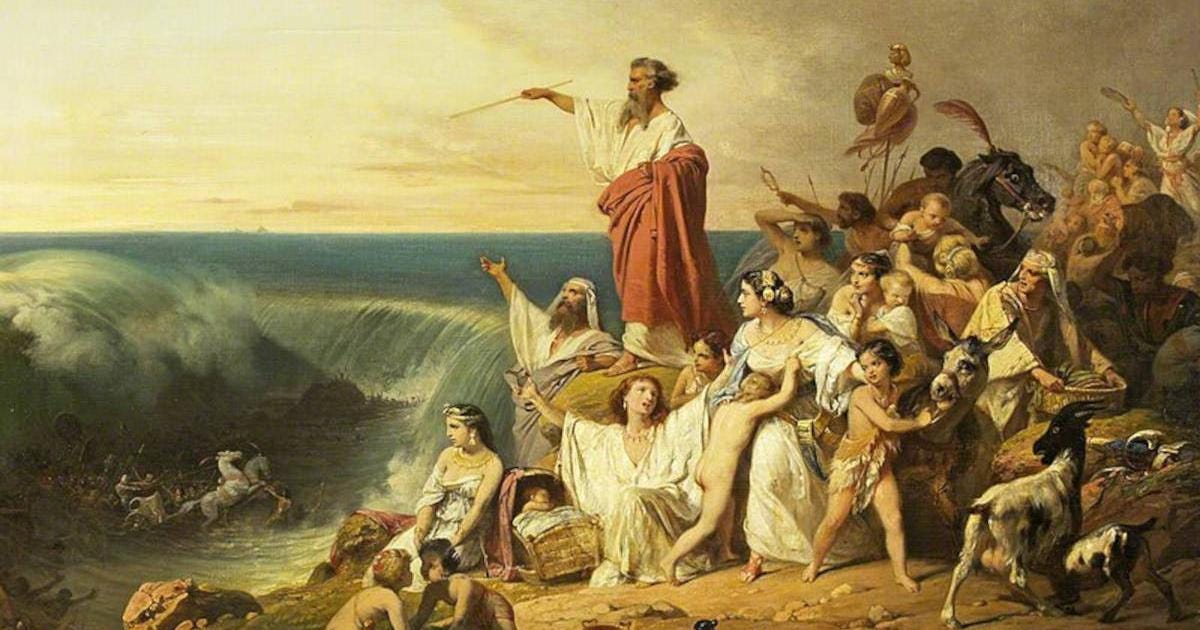
Now, through the lens of Christ, we can better comprehend other miracles which bear the same trademark. When Moses parts the waters of the Red Sea, the waters do not become mere raw material in his hands. They are rather enlisted and consecrated as God’s host (in every sense of the word). Far from ceasing to be waters of chaos, they actually become God’s weapon of chaos against Pharaoh’s army. First, Moses lifts his hand, and the waters stand at attention on his right and on his left, as though awaiting orders. For a moment, they appear to have had their very nature stolen from them, as God’s people walk on dry ground. But that is only the beginning of the miracle. Then Moses raises his hand again, and the waters fall upon their enemies, simultaneously obeying their own nature and God’s greater purpose. The sign becomes a sacrament. The waters become the hand of God without ceasing to be waters. What was once “good” is now being made perfect through Moses’s faith.
But what of the mountains we wish to move? Mountains, too, are more than raw material. They were called good when God made them, and that goodness remains. The believer trusts the goodness of the mountain, even if he cannot yet see it, even if the mountain stands in his way. In fact, death and mountains are most alike—and perhaps most like God—in their permanence. The glory of a mountain, one might say, is to be immovable. But the even greater glory of a mountain is to move when Adam says so. And the glory of Adam is to represent God’s wisdom, not his own, when he tells the immovable to move. If all goes well, the mountain submits to Adam as Adam submits to God, and both mountain and mover are perfected in the process. But all does not go well. Adam abandons his post. And so Christ comes to restore it, announcing that through him, the new Adam, we can finally say to the mountain, “Move from here to there,” and it will move.
I do not mean to say that all prayers take this shape, by the way. Not all prayer requires the authority to command a mountain. The bleeding woman and the blind man do not speak to their own bodies. They pray to Jesus to do what they obviously cannot do of their own accord. This is the kind of prayer with which we are most familiar. Like Frodo singing Tom Bombadil’s song in the tomb, we pray most often as children asking our Father to do what we do not yet have the authority to do. We ask, and he responds. When the small child pleads, “Daddy, tell Fido to give me back my toy,” a good father does as he is asked. All prayer must begin this way.
But it will not be long—and the child will not have grown very much older—before the father says something more like, “Why don’t you tell Fido to give the toy back?” Probably he will say it with a smile on his face the first few times, but he will have meant it nonetheless. After all, the dog is not only his but his child’s. And he wants his child to know his authority by slowly putting it into practice. The father is in the business of imparting his dominion, however annoyingly ineffective it might be for the child at first. Like an instrument you do not yet know how to play, there is no other way to learn besides trying and failing (at first) to play it. It will not just “happen.”
Likewise with mountain-moving. We are not told that, if we have faith, we will ask the Father to move the mountain, and he will move it. We are told rather that we will ask the mountain, and it will move. I grant that the two are intimately related. The child’s authority comes from the Father’s. In a sense they are one and the same authority. But they are not the same act. Like the child with his dog, we are meant to embody the father’s authority within ourselves, to make it slowly and faithfully ours, not as usurpers but as heirs.
No one explains this notion better than Lewis’s Screwtape, senior devil in the Tempters’ Training College:
To us a human is primarily food; our aim is the absorption of its will into ours, the increase of our own area of selfhood at its expense. But the obedience which the Enemy demands of men is quite a different thing. One must face the fact that all the talk about His love for men, and His service being perfect freedom, is not (as one would gladly believe) mere propaganda, but an appalling truth. He really does want to fill the universe with a lot of loathsome little replicas of Himself — creatures, whose life, on its miniature scale, will be qualitatively like His own, not because He has absorbed them but because their wills freely conform to His. We want cattle who can finally become food; He wants servants who can finally become sons. We want to suck in, He wants to give out. We are empty and would be filled; He is full and flows over. Our war aim is a world in which Our Father Below has drawn all other beings into himself: the Enemy wants a world full of beings united to Him but still distinct. [...] For His ignoble idea is to eat the cake and have it; the creatures are to be one with Him, but yet themselves.
That’s as far as I’ll go today. In my final installment, we’ll explore what this dominion might look like in practice: how to proceed from asking God to move mountains to asking the mountain to move by God’s authority (and our own). As hard as it may be to imagine, Christ has given us his Spirit and has promised that we will do even greater things than he. This is our inheritance. And creation waits with eager longing for the children of God to be revealed.
Many thanks to A. A. Kostas and Zach Kuenzli for the gracious help editing this one. If you enjoyed this post, please hit the LIKE and RESTACK buttons below. Thanks!
Science, properly understood, is exactly the sort of thing I’m after when I speak of dominion and mastery…but more on that in the last essay.
“Praise the Lord from the earth, you great sea creatures and all ocean depths, lightning and hail, snow and clouds, stormy winds that do his bidding” (Ps.148:7-8). The Psalmist gets the true purpose of dominion.
Okay fine, Death’s obedience to Christ was not quite this straightforward. There was also trickery involved (a topic I have discussed elsewhere). Since Death had become a servant of the Enemy, it would not easily obey. It had to be tricked first before it would repent and submit. On the cross, Jesus plays the role of Tamar and Death the role of Judah. This is how Death is converted and perfected.
You are pulling so many threads into this grand weave, it’s hard to remember they were all separate before.
Instrument/device.
Mastery/genie.
What I would call the Gandalf/Saruman distinction, or Wisdom/Sophist or Love/Control.
Call-and-response vs Cause-and-effect.
Tom as plausibility structure for Frodo.
Grace’s perfection of nature rather than its destruction or collapsing of nature (death, Moses, etc.).
Bro. 😮💨
An erudite and wise final product