


Hi everyone,
For many people (myself included), September 1 is a kind of New Year’s Day, as the summer comes to a close and a new season begins. If you’ve been looking for the right moment to begin again with healthy spiritual patterns, today might be that day. I’d like to invite you to join my family and many others in committing to five simple practices which will help to re-embody your faith on a day-to-day basis. Here’s a quick synopsis of the five practices with some helpful links to get you started:
SCRIPTURE: We share a common reading schedule, usually one passage from the Old Testament, one from the New Testament, and a Psalm each day. Learn more: See my “How To Read The Bible” mini-tutorial BELOW.
PRAYER: We pray on our knees the first minute we get out of bed and the last minute before our head hits the pillow. Learn more: How To Pray
FASTING: Fasting makes space for God. We do it in different ways in different seasons (e.g. internet fast on Sundays; no meat or dairy on Fridays; special alms-giving in summer). Learn more: Why We Fast
CHURCH: Make a commitment to physically go and worship with other Christians at a local church every Sunday. Learn more: Losing Our Religion
AUTHORITY: Begin to ask God for a trustworthy pastor, priest, or spiritual leader. Then approach that person and give them authority in your life. Learn more: What Is A Priest?
If you’d like to read more about how these sorts of practices help to form and shape our faith and identity, check out my piece, Creeds, Deeds, & Needs.
September Scripture Readings
The readings for this month are as follows. If you’re the analog type, you can access the reading plan here and print it out or bookmark it on your phone or computer.
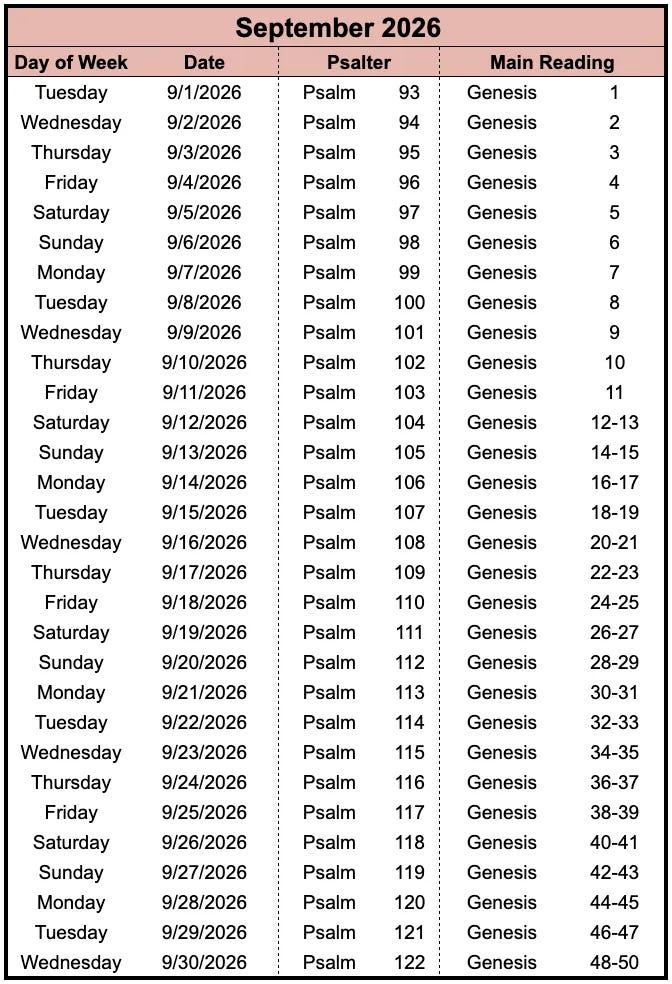
This month, we begin at the beginning with the Book of Genesis. In the past, the plan has consisted of three regular readings per day: a Psalm, an Old Testament passage, and a New Testament passage each day. Lately, we have simplified to a two-reading plan, just to help folks really form a consistent pattern. Baby steps, as they say. Hopefully we’ll move back to three readings before long. I HIGHLY recommend watching the excellent Bible Project video introductions linked below before you begin.
3 Quick Tips On How To Read The Bible
1. How Not To Quit: Ours is not one of those reading plans that takes a big time commitment. Again, we like baby steps. We have purposely kept it short and simple, so that it can be sustainable for a lot of people with different rhythms and attention spans to consistently do it together. Even still, some of us will fall off and miss a few days in a row. That’s okay. Don’t give up. Don’t feel like you have to go back and catch up. Just pick up on the new day and keep going.
2. How To Get The Most Out Of It: As I have mentioned before, I recommend saying a short prayer as you begin, then reading or listening to the two passages, then ruminating on some small part of the reading the rest of the day. I recommend having a couple of other people in a group chat who are also committed to read with you. Then you can share encouragements and questions about whatever stood out to you from the day’s reading over text. So, if you begin tomorrow, don’t do it alone. Invite one or two friends to join you.
3. How I Read The Bible: A number of people have asked me how I approach the Scriptures. Of course, I can’t exactly answer that here, but a couple of thoughts:
Rumination: When I was young, I would get so excited when I came across any part of a passage that I thought I really understood. And then (nobody told me to do this, but…) I would ruminate on that little nugget of light for the rest of the day. “How can I use that key to unlock other doors in the Scriptures? How might that key unlock doors in my own life?” Etc. It helped me a lot. Now that I’m a 40 year-old geezer, I tend to get more excited about the bits of Scripture I don’t understand. I’ll take those dark, mysterious nuggets where Jesus says something seemingly incomprehensible, or where two back-to-back stories in a Gospel reading seem to have nothing in common—e.g. “Why on earth did Matthew place these stories next to one another?”—and I’ll chew on that the rest of the day. Rumination is a major, though somewhat hidden, theme in the Bible. Some truths can only be seen if you wait, stay awake, and keep your eyes on the seemingly invisible prize. So…ruminate.
Images Over Words: A big breakthrough for me was realizing that the Bible is made up more of images than words. Through our modern lens, words tend to be more important. We like things to be precise and technical. So when we see a certain word recurring, we want to give it a precise and technical definition. “Justified…what does that mean?” [Google what the experts say.] “Oh, now I understand. Ok, sanctified…” [Repeat the process.] Don’t get me wrong, you can learn good things that way. But ultimately, it won’t go deep enough. When Paul, for instance, uses the terms justification and sanctification, he’s not merely using technical terms. Justification is an image from the world of the law court. Sanctification is an image from the world of the temple. When he uses these terms, he doesn’t just want you to cognitively understand. He wants you to step into the picture he’s painting. To come into his world. This is why Jesus speaks almost entirely in images or parables. Even the actions he takes—healing a blind man, feeding 5000, pulling a coin from the belly of a fish—are more like living parables (like the dramatic acts of OT prophets) than mere factual occurrences. Once you see that, the Bible comes alive in a new way. Across the Old and New Testament, images hyperlink to each other far more effectively than mere words. Once you see the images, you begin to see the connections. Another way to say it: the words on our Bible’s pages are simply not the words of the original text. They are translations from at least three different languages. Specific words themselves may even be debated. But the images remain transcendent. The words are there to express the images, and the images are there to express realities that go far beyond words. In a possibly apocryphal story, Hemingway was once asked how he managed to write so simply and briefly. His response was, “I would use no words if I could.” Hemingway didn’t want his readers to get caught up in the narration itself. He wanted them to feel like they were living in the pictures he presented. He wanted them to taste and see, not merely to define and understand. In this, I think he was accidentally imitating Jesus.
Participation Over All: As Evangelicals, we are fond of referring to the Bible as “the authoritative word of God.” By this we tend to mean that the Bible is without error or untruth. I, of course, agree that it is 100% trustworthy and true. But the word “authoritative” has a much more important meaning, which we sometimes forget: it must be obeyed. You will not (cannot) understand the God of the Bible until you begin to do what he says. So remember that as you read. Every story, every song, every command is meant to be applied to your life by means of participation in the kingdom it introduces. The Bible is meant to be lived. So begin to live it as you read it.
Anyway, God bless you and happy reading!
— Ross
P.S. The summer has ended, and my final installment of “On Moving Mountains” will be out soon! It’s almost finished. To those who have been faithfully reading along since last year, thank you for your patience. If you haven’t read them or want to be reminded, here are the first three installments:


Loved the section on "Images over Words" 👏